Tuesday, July 10, 2012

The Color of the Year Is....

As marketers we all think of color as a part of our brand guidelines.  Interesting while many brands strive for consistency in color the world in which brands live are in defiance of such consistency rules.  From automobiles to fashion the staple colors of black and white always ring true but then the tug of war takes place to determine where the social acceptance of color will land. 
In 2012 the Pantone Color of the Year is Tangerine Tango!  
To get all the RGB details on the color visit the Pantone Website .  The color is described and romanced from seductive to sophisticated on the Pantone website along with pics and where the color will arrive in the fashion world.  As a marketer if you find yourself needing to make a color choice but have some liberty to choose (or indifference) you could always choose Tangerine Tango and justify that you are keeping up with current trends.
Color does keep our world interesting as marketers because it gives us something new to say- and show off.  Remember when Mac created the big bubble like monitors (iMac) that looked so compelling on TV (Click for Commercial)?  Recall when Motorola StarTac flip phones just came in shades of black and then Nokia introduced an array of colors and mobile phone’s transformed from a communication device to a fashion accessory?  Mobile phones remained fashion forward through the Moto RAZR days until ironically Apple took the color away and replaced mobile fashion with mobile functionality of the better user interface and mobile ap frenzy delivered by the iPhone.  Fear not as Apple has once again found its color in the latest iPad even better Retina displays (Click for Commercial).  I only wonder if Apple would consider Tangerine Tango?
Many things in life are black or white but never forget we all live in color. 
MarketngGr8nes- An Aspiration Not a Declaration

Tuesday, July 3, 2012

Looking Back at the Up-Fronts


X-Factor at the Up-Fronts

What would you learn about your brand if roles were reversed?
Back in May $9B of TV advertising money was in NY looking for TV networks to call home for their messages in 2013.  Media buyers united in for a barrage of presentations, performances and parties put on by the TV networks putting their best content forward hoping to lock up the share of the wallet the audiences had available.  From Radio City Music Hall to Carnegie Hall the TV stars, rappers, talk show hosts and Network Executives were put on display for all to idol.
Every presentation spoke to which audience the network dominated (or plan to dominate).  Men to women, general market to Hispanic, working class to affluent every audience appeared to have a network that was prepared to own their ratings.   Each network promised content by day and daypart (AM to late night) that was sure to dominate drama night, comedy or reality.
This brings me to your brands reality.  At the up-fronts network executives had to pitch their programming, their content and ultimately what their network was all about.  The hope was different corporate brands would see the parallels between themselves and networks and conclude- “CBS is the network for my company!”  Based on who they both dominate, when they dominate and what they stand for it should be obvious how brands and networks align.
THE FANTASY:
What if the roles were reversed between your company and the Networks?  Imagine a fantasy state where all the Networks showed up to NY to hear each of the Fortune 500 brands CEO come on stage and say “welcome to the (insert your company name here) upfront”.  Imagine if Networks had so few commercial slots and so many advertisers they were in the driver’s seat.  What if you and your executives had to sell your company to the Networks to get air time?  If successful your company would be allowed to air your messages on desired programming.  Otherwise, your messages would be shut out.  Talk about Reality TV!  How would your brand win and stand out?

THE REALITY:                                                                                Eli Manning (CBS Upfronts)
First your brand would have to have a very clear consumer strategy that appealed to the Network executives.  Who do you really want to dominate demographically?  Psycho-graphically?  Attitudinally?  When do you want to engage and why?  AM, evening or late night?  The basics will have to be covered as table stakes in the minds of the Network brass.  Many marketers’ at this point are exhaling a big “duh” right at this point.  Customer segmentation is a basic.  However to the picky Network President they will ultimately check all the basic boxes and still seek the answer- “why should I select your brand to advertise in my #1 hit show that has limited advertising slots?” The answer ultimately will be found in your brands purpose.

PURPOSE:
Your brand’s purpose is simply why the brand should exist to the customer?  An insurance company’s purpose may be to provide “peace of mind that anything gone wrong will be made right immediately”.   It would organize them to have 24 hr call phone support, fast dispatch of a claim team, counselors on hand for crisis management.  Do all of these programs have a measurable ROI?  Hard to say individually if they each have a payout.  However your brands purpose leads itself to your company’s overall ROI.  It provides your marketing to work harder because it has something meaningful to message.  It provides a reason to desire your company as a consumer.  It provides an easy way to validate initiatives on your white board should be in or out by simply asking, “Does this program pay off on our companies purpose?” 
In Adage a popular search engine’s purpose was cited to be “to satisfy every curiosity”.  Makes sense because anyone searching on Google is on a quest for knowledge.  A retailer’s purpose may be to allow people a “higher standard of living through lower prices”.  These are not advertising language, its internal language.  It’s how you organize your company internally as well as marketing.  However a purpose comes with responsibility which could extend beyond marketing.  PR, corporate relations, employee training and scope of your business could all be impacted.  In short your purpose is a key cog in your strategy.  In this "pretend" retailers purpose they may strategically forgo investing real-estate in affluent neighborhoods- a decision they may not have made without a purpose.
Let’s stay with the purpose of “higher standard of living through lower prices” as it is a popular one with several retailers.  The products the retailer buys to re-sell must be able to meet the purpose, the companies cost structure must be able to support the purpose.  Perhaps buyers at this retailer call vendors collect to save on their phone bill to reduce their cost structure even more (don’t laugh I have heard tell of this very action at the big W).  Only when a company truly rally’s behind the big idea will the advertising actually ring true to the customer.  The invitation will match the party and the “cumulative” effect will take hold.  Your purpose is genuine!
If you asked ten people “what do you think Wal-Mart stands for?”  You probably would get the majority of them answering something having to do with low prices.  Like their purpose or not they have one and their company rally’s around that idea.  A network executive who dominates the struggling middle class may have determined that Wal-Mart is a brand they would want on their network.  HGTV may have desired Home Depot.  ESPN may have determined Dick’s Sporting Goods were for them.  CNN may have determined Viagra has a place on their Network- but I won’t get into that.
 CHALLENGE:
After you determine who your customer segment is or should be, ask yourself the question you should have considered beforehand.  What’s your brands purpose?  Why should your brand exist on the competitive landscape (consumer facing)?  Blockbuster’s purpose should have been all about delivering video entertainment for those who seek to be entertained- not video or DVD rentals.  With the right purpose, where ever entertainment was happening Blockbuster’s R&D should have been there.  From the red carpet to your living rooms carpet entertainment has no boundaries so why should Block Buster confined themselves?  Reinvention of how your company pays off their purpose is the strategic plan not reinventing your purpose every year.  A purpose strategy would not only have won over the Networks CEO’s in this fantasy example but will win you customers today in reality.  Ask yourself now- “what is my company’s customer facing purpose?”  Many don’t have one and wonder why they struggle. 
Please share your company’s purpose or lack of one and comment!

Friday, February 3, 2012

The Super Bowl Reveals a Lesson in Loyalty Programs

(Who will you be loyal too?)
It’s that time of year where being indecisive is not acceptable.  People across America every NFL Championship weekend flock to parties, bars or their own living rooms often routing for a team that they haven’t routed for all year.  In fact check out your own party where guests are not even fans of the game but found some trivial reason to cheer for a team because of who the quarterback’s wife is or the color of their uniforms.   
People want to have a point of view.  They want to have a protagonist and an antagonist.  Every good book or movie has some of the base components to sway reader or viewer to a side.  A good story can make you route for an unlikely person or villain depending on the lens it is told through.  It’s the basic human social trait that compels us to pick a side.  In business we look to marketers to help harness the human trait and compel behavior to have the masses adore and frequent our brands.  This is often achieved through loyalty programs which is often seen as a “must have” part of many consumer facing businesses and often is a culprit in eroding profitability and not achieving the behavior change desired in the first place.
WINNING IN INDIFFERENCE IS THE KEY
If loyalty programs are about changing behavior it needs to often be reminded to do it in a profitable way.  I often determine when to have a loyalty program with three simple rules:

Let's tackle each scenario starting when to avoid loyalty programs.
DISLIKE FOR YOUR BRAND:
Assume consumers had a large amount of dislike for a brand.  They were not “indifferent” to it but preferred to avoid it.  In fact, in some cases the consumer was what we call a "negative Nancy".  In other cases there was no emotional hatred by the customer for the brand they just preferred not to buy it.  Offering loyalty to something consumers say they don’t like will NOT make them like it more.  So loyalty programs often won’t work and erode profitability.  Example:
Let’s assume at one time McDonald's had an issue with the health conscious consumer.  Fast food in general does have this issue but Subway Fast Food  became known for having smart eating choices and a spokesperson that was once 400lbs now at a normal weight attributing the life change to his favorite fast food chain.  Should McDonald’s have given extra Big Mac Points for every Big Mac sold?  No!  The marketers at McDonald's were too smart for that.  In order for McDonald's to move the needle with the health conscious eater they had to do something much more fundamental to gain their loyalty- change the menu.  Adding salads and oatmeal as choices vs. hamburgers and breakfast sandwiches enables McDonald's to compete for the loyalty of that consumer.
LOVE FOR YOUR BRAND:
Jumping to the opposite side of the equation if the public by in large loves your brand you may not want to provide a loyalty program.  Remember if it is about behavior change (more trips, larger basket etc.) and you already have a loyal following there may not be enough room for significant consumer change.  Let’s have fun with coffee.
Assume you had a coffee shop by your house that you loved like a Starbucks.  Every morning the line is packed and on weekends etc…  You see a lot of the same people in the shop and cars in the drive thru.  Assume Starbucks thought that 50% of their customers at this location were regulars.  In order to try and spike sales it was decided to give away a free coffee to every 5th purchase.  Sounds good doesn’t it? 
Problem is on 50% of their sales they are now giving away a free "cup of Joe" every fifth transaction.  Since that regular customer really couldn’t come in much more than they often do this leads to a 20% decline in revenue and profits (giving away one cup of coffee free every fifth time).  It would take the other 50% of the customers to have to come in 20% more often just to break even!  In my career a 20% lift would be pretty remarkable.  In this case it would be pretty risky.
Starbucks found a way to make customers loyal through a great experience, great product and great people.  Think for yourself the level of customer service differences between the two establishments we discussed (Starbucks and McDonald's).  Clearly different.  This allows Starbucks to command a premium for their products like a $5 Vente coffee (but they need that premium to maintain that experience) and McDonald's has less room to command a premium but their promise of "easy simple enjoyment" is more founded around consistency with food, service etc.  Neither model is wrong just different.  However in both cases loyalty programs (ex points programs or free give away) are probably not needed, prudent or necessary.
INDIFFERENCE FOR YOUR BRAND:
Indifference is the battleground for loyalty programs.  Think about airlines.  A person who just started becoming a regular flyer with no restrictions of airlines was faced one day with a flight to New York and could choose United or American Airlines.  For no real particular reason other than flight timing she chose American.  After the trip she earned several thousand miles because she was signed up for a frequent flyer card at the airport.  The next time she flew she was still just as indifferent as before but now she was 2,000 miles closer to her free ticket so she chose American again because there was no real compelling reason to change airlines from a price, destination or timing need.  The more she travels the more she is locked in on getting that free ticket and loyalty becomes apparent where there was none before.
Similarly let’s say “Bill” gets his oil changed at Jiffy Lube ever three months.  Oil changes are low emotional purchases based on convenience and price.  Recently a Metro-Lube opened near Bill.  Both businesses are very similar in all ways to Bill's perspective.  So he often began to flock to the place that had the shortest line when he had his oil changed.  This was fine until Metro Lube convinced Bill to join their loyalty program.  Now Bill gets his car vacuumed out for free and upgraded to better oil.  Perhaps Bill gets a free oil change every 4th time in.  So now Bill actually is waiting in a longer line than the Jiffy Lube across the street because he has a vested interest to pick a side.  This investment may be good for Metro-Lube if they saw a lot of indifference and the majority of their customers were not really "regulars" even if they had their oil changed at Metro-Lube before.
WRAPPING IT UP
The battle field is finding your indifference and then break that tie with a loyalty program!  Some brands are so poorly positioned they actually need to move up to indifference.  Example a long time ago Montgomery Ward may have lost apparel customers because of new off mall retailers who had better fashion cache.  People may have slowed down purchasing at Ward’s because they started to feel the brand was like Oldsmobile (offered low badging).  Perhaps it was convenience or one of any number of issues that hurt the company.  The point is Montgomery Wards probably could not have saved themselves through a points program but rather they needed to “fix their menu” like McDonald's did.  Address what consumers disliked so to reach a point of indifference and then work on a loyalty program.  If she sees no difference in JCP or Kohl’s than she will ebb and flow to both outlets but if she dislikes one of those brands more points will not provoke her to shop there.

So look around the next time you are at a football party or bar for a big game.  Look at how many people are NOT pulling for one team or another.  Most people have a point of view at game time and a team they are pulling for.  However in everyday life many consumers are caught in the land of indifference waiting for you to harness it, wanting you to choose a jersey for them and give them the comfort of a point of view!
I put it to you.  What brands have your loyalty and do they have a loyalty program?
MarketingGr8nes
An Aspiration Not a Declaration

Tuesday, January 3, 2012

Marketing Masters is Now Live

For those of you who only see me in print or via email I wanted to kick off the new year with a little audio.  I have been blessed with the honor of being on the CBS Altitude Marketing Masters series.  If you are in a top ten market in the US you may here me on your radio dial talking about marketing (for 30 seconds).  If you would like to hear the entire interview and understand my passion for radio, where I came from and how I started my career in marketing (which may shock you), this interview is for you.  Happy New Year!

Find the interview here on CBS Altitude: CLICK HERE

Monday, November 21, 2011

Before Black Friday Shopping- Top 10 Things You Should Know


1) Look-up the Specs:  Lots of deals can be disguised in the specs.  So understand the specs you “must “have and then evaluate the deal.  Example- you may find a great deal on an HDTV and you see that it is 1080P, 46 inches and LED.  You think you are all set however you didn’t realize its 60 Hertz (so fast action sports may not be optimal on this set).  Additionally the set only had 2 HDMI inputs.  As a result you can connect your Satellite TV Service and your Blu-Ray player but not your Gaming system or surround sound.  Although it was a good deal, it’s a product you will grow tired of soon.

    2) Look at your WHOLE basket:  Often one item savings can predict where you want to shop for Black Friday.  However, many people buy multiple items on Black Friday and the savings on one of them can be offset by the lack of savings on the other.  It may be worth paying a little more on one of your items if it means you get the secondary items at a better deal. 

3) Decide Broad Line or Specialty Store: Many consumers realize after they endure the long lines and crowds to get their prized Black Friday purchase, the chance of getting to another store to get another prize purchase is greatly reduced because most stores have limited quantity inventory on Black Friday.  Let’s face it, a parking spot is hard to get at a second store much less that $99 camera quantity 2 per store!   Choosing a broad line store that carries an array of products from electronics, appliances, clothing, shoes, tools, jewelry etc. can increase your chance of getting another prize buy in a different category.  Stores like Wal-Mart, Target or Sears offer a broad array of products without having to leave the store and may be able to check them all at one register.  Other stores that specialize in electronics, clothing or furniture may provide one prize purchase but leave you desiring more unless you are infatuated with the category they sell.


4) Pre-Shop for Efficiency:  If you really want to get in, get what you want and get out- pre shop!  Find out days before where the item you want will be on the floor.  Black Friday can turn a store you are familiar with upside-down.   Bulk stacks in isles and shopping carts by the registers can present merchandise where it is not normally located.  Retailers may put door busters in the back of the store to get customers to walk through the store to get the prize item.  Ask the store associates where the items you want will be located so you will be fast an efficient while others are seeking out an associate asking where something is.

5) Check On-line for Preview Shopping: Some retailers will put Black Friday deals on-line before the store opens as a function of getting their site up and running.  You may be able to score that item without leaving your house.  WARNING- expect slow response times as site traffic may bog down performance.  Make sure you are on the fastest internet you can get to not contribute to the problem.  Also note- not all door busters are available on-line.

6) Look for “One Per Customer” Offers or Else:  I have heard stories at one retailer that had a great deal on TV’s with limited quantities per store.  After waiting all night, the first person in line asked the clerk- “How many do you have?”.   When the clerk informed her they had 15 of the TV’s, the customer said “I’ll take’em” creating a near riot in the store and some physical altercations because others had stood outside all night for the deal.  Knowing the store you shop is planning on allowing one per person will prevent you from being disappointed.

7) Divide and Conquer: Having a shopping partner with you can really allow you to split up in store to get the multiple items you want.  Also, safety in numbers if you are waiting out in line all night.

8) BYOB: You may want to “Bring Your Own Bag”.  If shopping carts are not in the store or if they are all taken, you may find lots of smaller impulse items you want but pass up due to physical ability to carry.  Having a nice shopping bag that you can put the items into is handy.

9) Cash or Credit:  If you are the paranoid type you may want to safely bring cash with you that can cover your purchase.  Reason is credit cards will be stressing the point of sale systems on busy shopping days.  If you are buying something that is coming from a warehouse and being delivered (with minimum quantities) you run the risk of having a payment processing problem while other stores are ringing sales eating up the limited inventory.  So cash is king and as long as the register is working, the payment can be accepted.  Again, this may be rare but is a possibility.

10) Bring the Ad:  If you are buying something that is in print advertisement- bring it!  If there is any confusion you can always reference the ad.  Customers often misinterpret ads and stores at times have a mis-print.  Having the ad as opposed to your memory can be handy.

But Wait!  There's More- BONUS TIP

11.  Understand the MAP (Manufacturers Advertise Price):  Often many manufacturers have MAP policies- (Manufacturers Advertised Pricing).  This means retailers CAN NOT show the price they are willing to sell a product for.  You often will see in a circular “priced lower in store” or “before $x savings”.  This is due to MAP policies.  Other times some stores will “blind the brand” meaning they will show the item (say a TV) but not the brand (ex. Samsung).  The store will advertising “Brand name 1080P LED TV for $1,000 save $400”.  This is because the brand won’t allow their product to be shown at $1,000.  Call the store and ask for the brand name.  A retailer will tell you the brand and are allowed by law to set their own retail price in store.  Advertising it is another matter.  Watch out for retailers who blind a less aspirational brand or bad brand hoping you will come in to the store.
Happy shopping and have a very Black Friday!

MarketingGr8nes
Not a Declaration, An Aspiration

Tuesday, November 15, 2011

Some Economics Thoughts Going Into Holiday

It’s that time of year again where we stuff ourselves at the Thanksgiving table and then stuff our cars in the wee hours following with early AM deals.  Consumers normally turn out in droves for Holiday deals and if the economy is any indicator I believe this year could be a boom or a bust depending on which lens you view the holidays through.  Let’s take a quick peek at what we are seeing economically.

Consumer spending/consumption is down in Q3 vs. LY while unemployment Jan YOY down but still high at around 9%.  So even with some better employment numbers consumers appear conservative at first glance as more are working but consumption is down.


When looking at what consumers are spending on you can see durables are down Q3 YOY going into the Holliday season where durables can spike when you think of gifts like big screen TVs or new stoves in time for holiday feasts or items to touch up the home in time for visitors. 


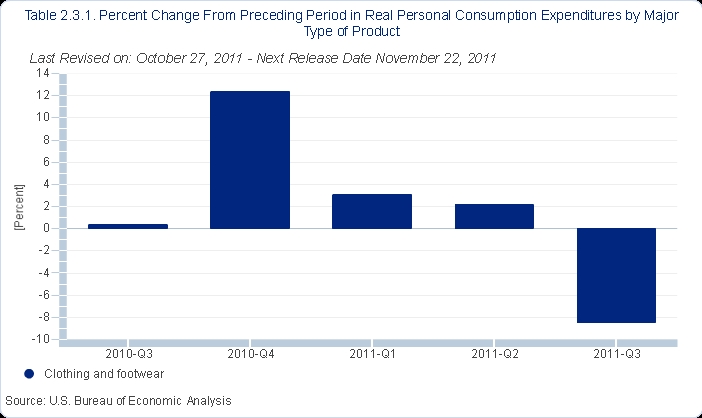
The question is where consumers are spending before Black Friday, and it appears it is not on apparel.   As the spending in this area appears to be down dramatically.  This in some respects could be the reason why some retailers like Target or even Wal-Mart may have a renewed focus on the consumable business.  If apparel isn’t driving the transactions and footsteps into the store then food may be the ticket to create frequency into the store.  Everyone's “gotta eat”.  See the apparel consumption trends YOY to the right.

As we step back and look at the disposable income (left) being way down YOY as of Q3. It could lead us to predict the lines might not be as long this shopping season. 


So disposable income is down.  Are the consumers just hording their dollars in savings ready to unleash on Black Friday or before Christmas?  Looking at the chart to the right, the answer would be no as year over year savings is down too.


I am not a Swami and don’t have a crystal ball (at least one that works) but one theory is money is tight and getting the most out of your disposable income means Black Friday shopping is a must this holiday.  It looks as if stretching the dollar is not only desirable, it’s necessary.  The question is, even if the will to shop big on Black Friday/Holiday is there, will the bank account and disposable income be available to take full advantage of the shopping time period?  If not, does the return to over extending on credit make a come back?  To be determined.
HAPPY HOLIDAYS

Data from U.S. Department of Commerce Bureau of Economic Analyisis